
Health Canada Study: Summer Radon Tests May Read Low, But They’re Still Worth Doing
A new Health Canada study, published May 22, 2026, backs up something radon professionals have seen for years: the time of year you test can affect your result.
For Winnipeg homeowners, the biggest takeaway is this: a spring or summer radon test may come in lower than your home’s true annual average.
That matters because Health Canada’s guideline of 200 Bq/m³ is based on long-term exposure, not a single seasonal snapshot. A home that looks just under the guideline in summer may be closer to the action level when measured over a full year.
Here’s what the new data shows, what it means for Winnipeg homeowners, and what to do if you’ve already tested.
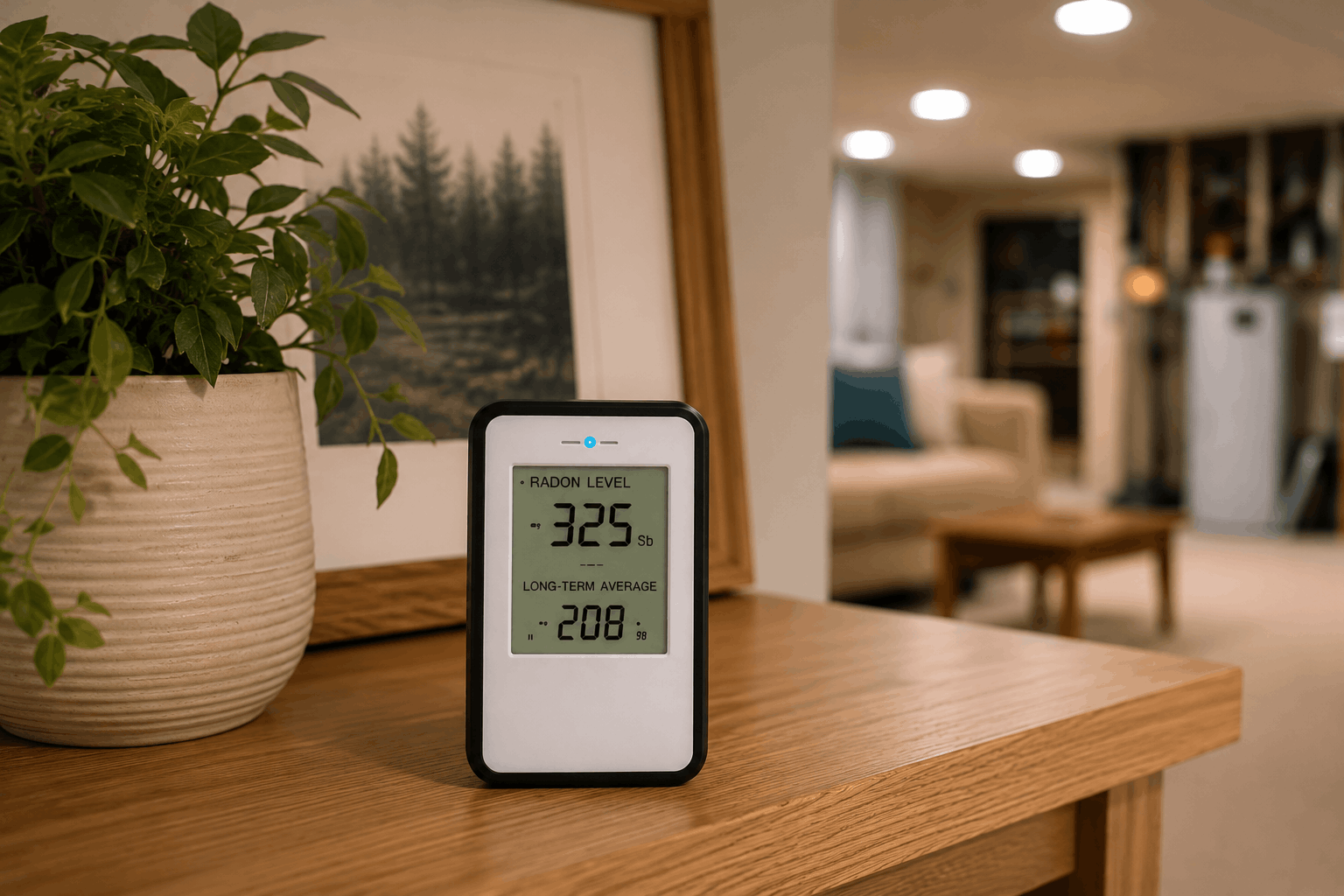
Early results from Health Canada's May 2026 seasonal radon survey found that summer tests tend to underestimate annual radon levels in every region of Canada, including the Prairies, where Winnipeg homes averaged 14% lower in summer than their annual reading.
What Health Canada's New Study Found
In September 2023, Health Canada's National Radon Program began a national study tracking how radon levels vary by season inside real Canadian homes. Each participant ran 4 consecutive 3-month radon tests, one per season, alongside a 12-month continuous test, giving researchers a direct comparison between seasonal readings and the true annual average.
As of May 2026, 397 households across Canada have completed a full 12-month testing period. The early results show a clear pattern across the regions studied.
Summer tests tended to underestimate annual radon levels in each region of Canada
In the Prairies and Northwest Territories, the region that includes Winnipeg, summer tests ran an average of 14% below the true 12-month average
Winter tests in the same region came in 9% above the annual average, meaning winter testing gives a conservative, protective estimate
Spring tests in the Prairies were essentially neutral at just -1%, the most accurate non-heating-season option
Health Canada is careful to note these are early findings and that individual results can vary significantly. The data should not be used to mathematically adjust any existing radon reading. But the directional finding is consistent: summer tests reliably underestimate, and winter tests reliably give the most protective picture of your home's radon level.
You can read the full Health Canada report here: Seasonal variation of radon in Canadian homes: Early survey results — Health Canada
Why Does Radon Vary by Season?
Radon enters your home continuously from the soil beneath your foundation. What changes seasonally is how much of it accumulates inside.
In summer, Winnipeg homes are naturally more ventilated. Windows are open, doors are used frequently, and the pressure difference between the indoor air and the soil below is smaller. Radon that enters has more opportunity to dilute and escape before it builds up to measurable levels.
In winter, the opposite happens. Homes are sealed tightly against temperatures that can drop below -30°C. Ventilation drops sharply. The "stack effect", warm indoor air rising and escaping through upper floors and ceilings, creates a suction at the basement level that actively pulls more soil gas, including radon, up through cracks and penetrations in the foundation.
The result: the same home, tested in the same basement, can show meaningfully different radon readings depending on the time of year. Summer gives you the lowest reading of the year.
For more on why Winnipeg's winters create specific radon risks, see our post on the Winnipeg winter radon problem.
What This Means for Winnipeg Homeowners Who Already Tested
If your radon test was done between roughly May and September, this study suggests summer results in the Prairies may come in lower than the annual average. In the early data, summer tests in this region averaged 14% below the 12-month result.
For example, using the Prairie/NWT summer average as an illustration, a summer reading of 175 Bq/m³ would be roughly 203 Bq/m³ if it were 14% below the annual average. Health Canada cautions that individual homes vary, so this should not be used to adjust your own result, but it shows why summer readings close to 200 Bq/m³ are worth taking seriously.
A summer reading of 220 Bq/m³ already exceeds the guideline; action is recommended regardless of season
The concern is specifically for homeowners whose summer test came back just below 200 Bq/m³. Those are the results most likely to be giving a false sense of security.
What Are Safe Radon Levels in Canada?
Health Canada's guideline is 200 Bq/m³ based on annual average exposure. The World Health Organization recommends action at 100 Bq/m³. In Manitoba, approximately 1 in 4 homes tests above the Health Canada guideline, one of the highest rates in Canada, driven by the province's uranium-rich soil.
For a full breakdown of what different radon levels mean and what action is recommended at each threshold, see our blog on safe radon levels in Canadian homes.
Should You Retest Your Winnipeg Home?
Here's a simple way to think about it:
Summer test result above 200 Bq/m³: Act now. Your levels are above the guideline even at the season's lowest point. Radon mitigation in Winnipeg can reduce levels by more than 80%.
Summer test result between 150–175 Bq/m³: Retest during the heating season (October–April). Your annual average may be at or above the guideline.
Summer test result below 150 Bq/m³: Lower risk of your annual average exceeding the guideline, but retesting during winter is still the most accurate approach, especially if your basement is a living space.
Never tested: Test now so you are not totally in the dark on your levels.
How to Test for Radon in Winnipeg
The most reliable approach is a 90-day long-term test conducted during the heating season, placed in the lowest regularly occupied area of your home.
At Radon86, we start with a free 15-minute on-the-spot check that gives you an early indication of whether your levels may be elevated. If the result suggests a concern, we will walk you through the next steps immediately. If levels appear below the guideline, we recommend a trusted 90-day test kit to leave in place for a more accurate long-term reading.
You can also purchase a DIY long-term test kit to conduct the test yourself, then send it to an accredited lab for analysis.
The Bottom Line
Health Canada's new seasonal study is an important step forward in understanding radon in Canadian homes. The early findings confirm that summer testing, while better than no testing at all, consistently underestimates the amount of radon your family is actually exposed to over the course of a year.
If you tested in summer and got a result close to the guideline, the most responsible next step is a retest this heating season. If you haven't tested at all, now is the right time to start.
Book a free radon test, or call us at 204-807-1340. We serve all Winnipeg neighbourhoods.