
What to Do If Your Radon Levels Are High
If you have recently tested your home for radon, you’re probably wondering what happens next.
Understanding what the results mean and what mitigation involves can make the next steps feel clearer and less overwhelming.
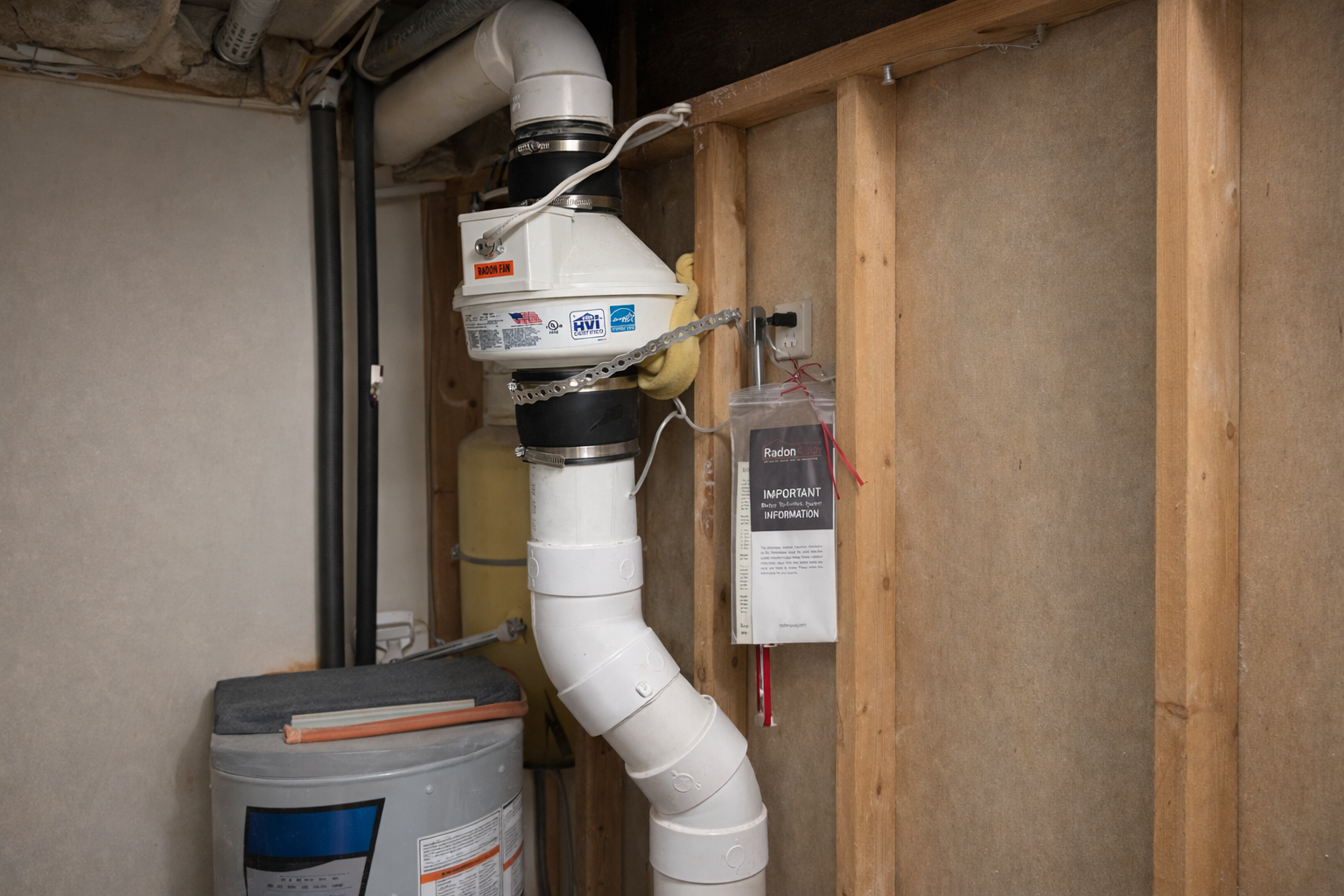
A typical radon mitigation system installed in a Winnipeg home. The pipe and fan draw radon from beneath the foundation and vent it safely outside.
What is Considered a “High” Radon Level?
Radon is measured in becquerels per cubic metre (Bq/m³). In Canada, Health Canada recommends taking corrective action if the average annual radon level exceeds 200 Bq/m³ in the normal occupancy area of a home.
A normal occupancy area means parts of the home where someone is likely to spend more than four hours per day. This can include a finished basement used as a family room, bedroom, or office.
For additional context, the World Health Organization recommends a reference level of 100 Bq/m³.
If your measured level is above the guideline, the next step is mitigation.
What Radon Mitigation Means
Radon mitigation, sometimes called radon remediation, is a system that lowers radon levels in your home.
In most Canadian homes, this is done by installing a pipe and a small fan that pulls radon from beneath the foundation and vents it safely outside. The system runs continuously to help prevent radon gas from building up indoors. This system is commonly installed in the basement or lowest level of the home.
Health Canada describes this approach, known as active sub-slab depressurization, as the most effective and reliable way to reduce radon in homes.
How Effective are Radon Mitigation Systems?
When installed properly, radon mitigation systems can lower radon levels significantly, bringing them below the Canadian guideline.
After installation, follow-up testing is strongly recommended. Health Canada advises confirming that radon levels have dropped below the guideline.
Some homeowners choose to keep a radon detector in their home to monitor levels over time or to retest periodically, especially after renovations or changes to airflow. Ongoing monitoring helps ensure levels remain low.
What Happens After a System is Installed?
Health Canada recommends confirming performance with testing after activation.
A short-term test can be done after the system has been running for at least 24 hours to show it is working effectively.
A longer test later can confirm that the annual average has been reduced below the guideline.
What if Levels are Below 200 Bq/m³?
If your test results are below the Health Canada guideline, mitigation is generally not required.
Health Canada also notes that there is no level considered completely risk-free, and reducing exposure further is a personal decision.
Why Testing Comes First
It isn’t possible to predict radon levels in a home. Even houses on the same street can have very different readings, which is why measurement comes first.
If you have not tested your home yet, start there. Our earlier articles explain what is radon and why basements matter when testing for radon, which may be helpful background.
What Homeowners Should Take Away
If radon levels are high, there is a clear path forward. The Canadian guideline provides direction, effective mitigation systems are available, and follow-up testing confirms results.
Radon mitigation is not about urgency. It is about making an informed decision based on reliable radon testing.
Need Help Understanding Your Results?
If you have received radon test results and are not sure what they mean, we’re happy to review them with you and explain your options.
Call us on 204-807-1340